
How to write a book blurb: five parts, two examples and Amazon's rules
How to write a book blurb in five parts, with a thriller and a self-help example, plus Amazon's book description rules: 4,000 characters, HTML, what's banned.
Short answer
To write a book blurb, use five parts: a hook, the main character or the reader's problem, the conflict, what's at stake, and a closing line that signals the genre, without giving away the ending.
- For the Amazon book description, KDP recommends a paragraph of about 150 words and allows up to 4,000 characters including HTML (as of November 2026).
Contents
A book blurb isn't a summary, it's a promise. Open with a hook that raises a question, show the main character or the reader's problem, set up the conflict and what's at stake, and close with a line that tells readers which genre they're holding. Never give away the ending. For the Amazon book description, KDP recommends a paragraph of about 150 words; on the back of a paperback, with logo and barcode, you have room for roughly 80 to 100.
Below you'll find the five parts worked through on two real examples, a thriller and a self-help book, Amazon's rules for the description field including the HTML it accepts, and the mistakes that make readers scroll on.
What is a book blurb for?
The blurb sits on the back cover of a paperback or the inside flap of a dust jacket. Online, the same text becomes the book description: on Amazon it sits on the product page next to your cover. It has one job: get someone to open the book or the Look Inside preview.
| Text | Audience | Length | Gives away the ending |
|---|---|---|---|
| Back cover blurb | readers in a shop | 80 to 100 words | never |
| Amazon book description | readers online | about 150 words recommended, 4,000 characters max | never |
| Synopsis | agents, publishers | one page or more | yes |
The five parts of a blurb
- Hook. One line, often bold or set apart, that opens a question.
- Character or problem. Who's at the centre, and in what situation? In nonfiction: what problem does the reader have, in their own words?
- Conflict. What happens that changes everything? In nonfiction: what does the book actually show?
- Stakes. What's on the line? In nonfiction: what does the reader have afterwards?
- Genre signal. The last line makes tone and genre clear so the right readers pick it up.
Book blurb example: thriller
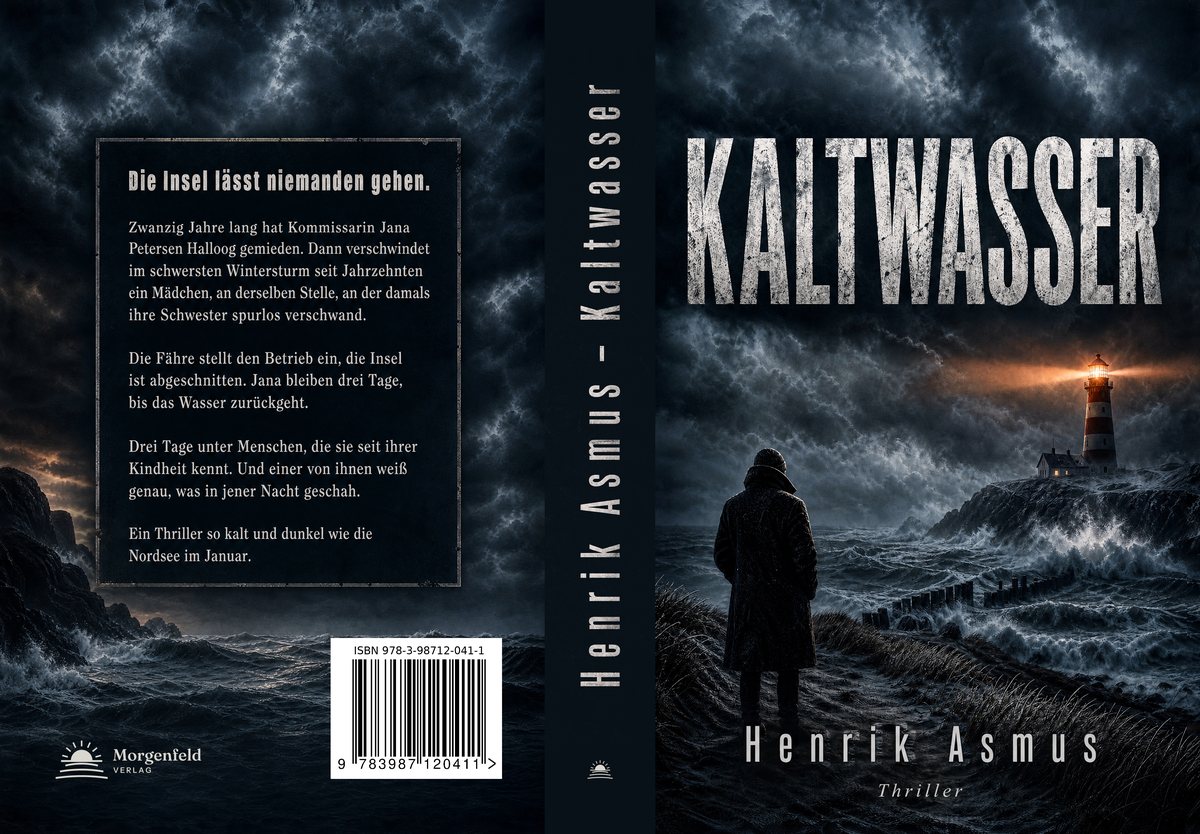
Here's the back cover of “Kaltwasser” in English:
The island never lets anyone go.
For twenty years, Detective Jana Petersen has stayed away from Halloog. Then, in the worst winter storm in decades, a girl disappears from the very spot where Jana's sister vanished without a trace.
The ferry stops running and the island is cut off. Jana has three days before the water goes down.
Three days among people she has known since childhood. And one of them knows exactly what happened that night.
A thriller as cold and dark as the North Sea in January.
| Part | In the example |
|---|---|
| Hook | “The island never lets anyone go.” |
| Character | A detective who has avoided her home island for 20 years |
| Conflict | A girl disappears where her sister disappeared |
| Stakes | Three days, cut off, and a neighbour who knows more |
| Genre signal | “A thriller as cold and dark as the North Sea in January.” |
Fewer than 90 words, no culprit named, no ending. The deadline (“three days”) and suspicion of familiar faces carry the tension, and the last line tells thriller readers: this one's for you.
Book blurb example: self-help
In nonfiction, the reader takes the place of the character. The back of “Endlich selbstbewusst” (“Confident at Last”), in English:
Do you say yes when you mean no? Does one critical look make you doubt everything?
In 30 short chapters, Mara Lindholm shows you where the quiet voice that makes you small comes from, and how to turn it down. With practical exercises, honest examples and a 30-day plan, you'll learn to stop tying your worth to praise, to set boundaries kindly and clearly, and to live with mistakes without putting yourself down.
No sugar-coating, no pressure: step by step towards a confidence that holds up on bad days too.
The opening questions are hook and problem in one. Then comes what the book delivers (30 chapters, exercises, a 30-day plan), then the result in three concrete points. The closing line sets the tone apart from other self-help (“no sugar-coating, no pressure”). You can see the full cover for it in our guide on the book cover template.
Amazon book description: rules and HTML
On KDP the description goes into its own field. The help page sets three limits:
- Length: 4,000 characters at most, HTML tags included. Recommended is an easy-to-scan paragraph of about 150 words.
- Formatting: basic HTML only (table below).
- Content: a list of things KDP won't accept.
| Tag | Effect |
|---|---|
<p> … </p> |
paragraph |
<br> |
line break |
<b>, <em>, <i>, <u> |
bold, italic, underline |
<h4> to <h6> |
heading (h1 to h3 not supported) |
<ul>, <ol> with <li> |
bulleted or numbered list |
According to KDP, these don't belong in the description:
- phone numbers, addresses, email addresses, URLs
- reviews, quotes, testimonials and requests for reviews
- advertising and promotional material
- time-sensitive information such as event dates
- price, availability, other ways to buy
- spoilers
- emojis
- keywords and tag phrases
Every tag needs its closing partner, and stray angle brackets in the text cause errors. Pasting from Word often brings invisible characters along, and KDP then says “Description may not contain invisible characters”; check the text in the source view if that happens.
Here's the thriller above as an Amazon description:
<p><b>The island never lets anyone go.</b></p>
<p>For twenty years, Detective Jana Petersen has stayed away from Halloog. Then, in the worst winter storm in decades, a girl disappears from the very spot where Jana's sister vanished without a trace.</p>
<p>The ferry stops running and the island is cut off. Jana has three days before the water goes down.</p>
<p><em>A thriller as cold and dark as the North Sea in January.</em></p>
Online you can run a little longer than on the back cover: a second paragraph on mood, or in nonfiction a short list of what the reader will learn. Beyond the recommended 150 words, few readers get to the end.
Common blurb mistakes
- A plot summary instead of a promise. Three paragraphs of plot answer the question you should leave open.
- Too many names. One character, two at most. Nobody remembers five names in 100 words.
- No genre signal. A romance that sounds like a crime novel finds the wrong readers, and they leave disappointed reviews.
- Giving away the ending. Even a hint like “in the end she finds herself” drains the tension.
- Empty superlatives. “Breathtaking” and “a must-read” say nothing about your book.
- Reviews in the Amazon description. KDP rejects them.
A blurb from your whole manuscript
The Bookfairy book blurb tool reads your whole manuscript, not a summary, and writes to exactly this structure: hook, conflict or problem, promise, no spoilers. You get six versions ready to paste: back cover, book description, Amazon HTML, KDP HTML, VLB XHTML and bullet points. The first lines are free; the full text costs $4.8040 tokens. The bullet points also work in A+ Content below your description.
Frequently asked
How long should a book blurb be?
For the Amazon book description, KDP recommends a paragraph of about 150 words, with a hard limit of 4,000 characters including HTML. The two back covers in this guide (135 × 215 mm and 125 × 190 mm) carry 83 and 86 words next to the logo and barcode.
What's the difference between a blurb and a synopsis?
A blurb makes readers curious and never gives away the ending. A synopsis summarises the whole plot, ending included, and is written for agents and publishers, not readers.
Can I put reviews in my Amazon book description?
No. KDP doesn't accept reviews, quotes or testimonials in the description, nor requests for reviews. Prices, dates, contact details, links, emojis and keyword lists are not allowed either.
Should a blurb be in first or third person?
Fiction blurbs are usually in third person, present tense, even when the novel is told in first person. Nonfiction blurbs talk to the reader directly, the way the book does.
Can I format my Amazon book description?
Yes, with basic HTML: paragraphs, line breaks, bold, italic, underline, headings h4 to h6 and lists. h1 to h3 are not supported, and the tags count towards the 4,000 characters.